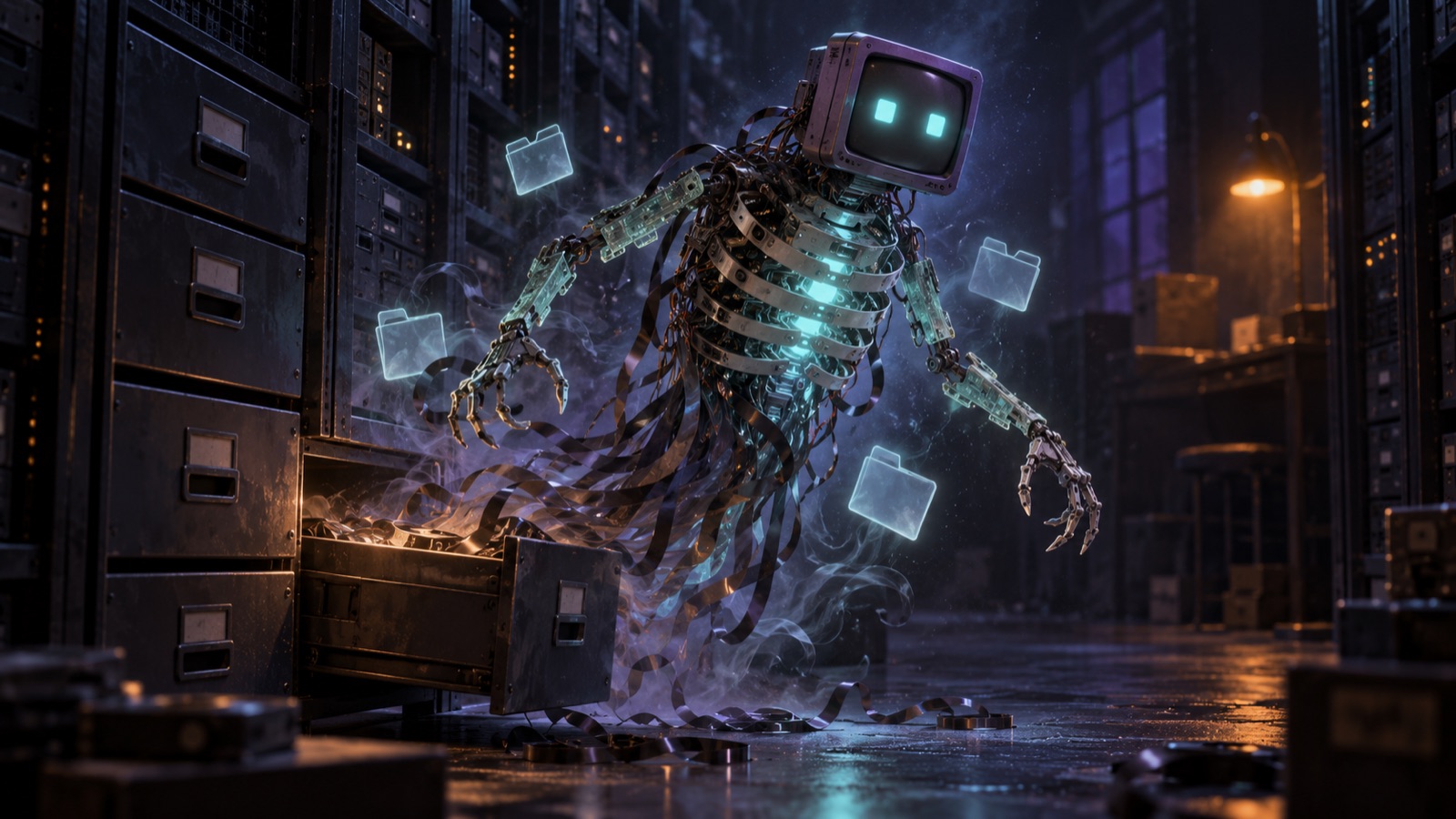
The Cachegeist makes its home in the files nobody quite dares to delete. Old presentations, abandoned holiday plans and documents called final-final-really-final gather around it like fallen leaves. In the folklore of haunted hardware, enough unfinished business can eventually learn to walk.
Its body is a loose arrangement of silver hard-drive platters, memory chips and translucent circuit boards. Magnetic tape hangs from its shoulders in long, restless ribbons. Two pale squares glow inside its hollow screen-shaped head. When it turns towards you, the room fills with the soft clicking of an elderly computer thinking very hard.
At first, its haunting looks almost helpful. A missing photograph returns. An old note opens at the exact line you need. Then a folder appears containing every version of a project except the one you actually finished. The Cachegeist has an excellent memory and absolutely no sense of relevance.
It is most active just before a deadline. That is when it rearranges imaginary archives, changes filenames by a single character and whispers the names of forgotten attachments. Its favourite trick is presenting a document you recognise, complete with a paragraph you are certain you never wrote.
Despite its unsettling habits, the creature is sentimental. It collects little traces of people: an unfinished birthday message, a badly named photograph, the first draft of something that mattered. It seems less interested in stealing the past than in making sure somebody notices it.
The fictional remedy is a farewell folder. Give one abandoned project a proper name, write down why it mattered and declare it finished. The Cachegeist will settle beside it for the night, quietly reading. Just do not call the folder miscellaneous. It considers that an invitation.
Leave a Reply